What actually separates them
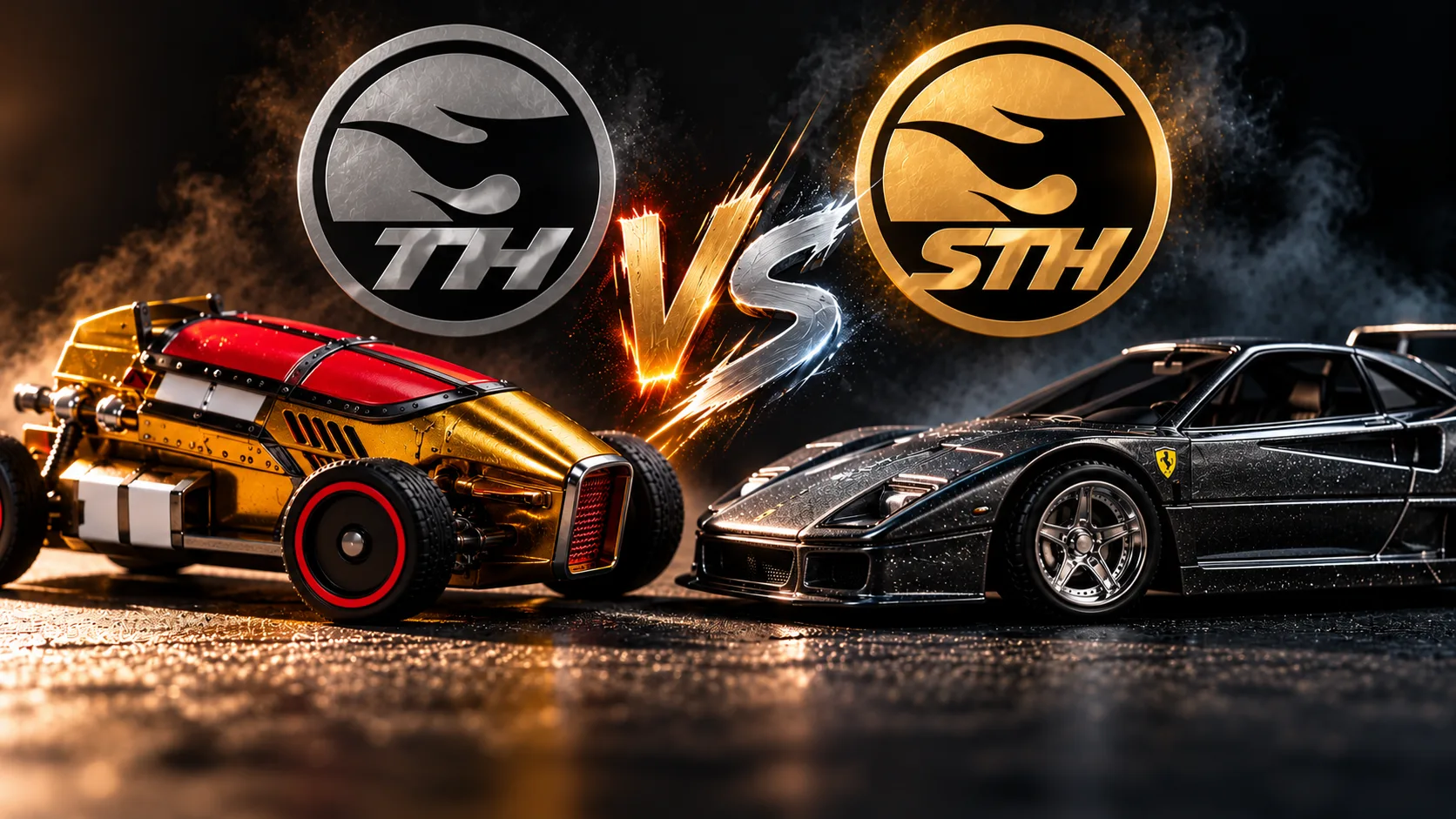
A regular Treasure Hunt and a Super Treasure Hunt are the same kind of car: a mainline casting, sold in the numbered series, hidden in the case for a collector to find. What changes is the finish, and there are three places to look.
| Treasure Hunt | Super Treasure Hunt | |
|---|---|---|
| Wheels | hard plastic | rubber, with a tread |
| Paint | flat, one colour | flake, shifts in the light |
| Badge on the card | grey flame | gold flame |
The order matters. The badge is the official answer and the least useful one in practice, because it is on the card and the card is what gets thrown away. The wheels are on the car.
Check the wheels first
If you learn one thing, learn this one: rubber tyres mean Super.
Our catalogue holds 1,124 regular Treasure Hunts and 664 Super Treasure Hunts, and
the wheel field splits them almost cleanly. Of the 651 Supers with a wheel code
recorded, 585 run rubber — the codes you will see written as RR, RRE or
RR5SP. Of the 1,088 regular hunts with a code, 934 run hard wheels.
So the test is not a rule with exceptions to memorise, it is a majority that is large enough to bet on: turn the car over, look at the tyre, and the material tells you which line you are holding.
The paint is the second signal
The second difference is the finish, and it has a name. Mattel calls it Spectraflame: a metallic flake coat that changes colour as the light moves across it. 432 of the 664 Supers in the catalogue carry a Spectraflame colour name, which makes it a strong second check after the wheels.
It is a signal rather than a guarantee, and it is worth knowing why: a wheel is a part number, while a colour name is a description. The wheels are recorded consistently, the paint name less so. So use the paint to confirm what the wheels already told you, not to overrule them.
The badge is the third check
The two flame logos are the official way to tell the lines apart, and the one most collectors learn first. Grey flame for a regular Treasure Hunt, gold flame for a Super.
They are also the check that fails most often in practice, for two reasons: the badge lives on the card, and the card is what gets lost. Treat the badge as the confirmation, not the test.
Two of each
The four cars collectors open most, two per line, and the pattern is visible in the specification itself: both Supers carry a Spectraflame colour and a rubber wheel code, both regular hunts a plain colour and a hard wheel code.
Two lines, two eras
The regular Treasure Hunt line starts in 1995 and the Super line in 2007, and the twelve years between the two dates explain why collectors mix them up. The early hunts were mainline castings given a special paint and a badge: a metalflake finish and the grey flame. The Super line, twelve years later, added the two things this article is about — a rubber tyre and a Spectraflame finish.
So the difference between the lines is material rather than graphic. It survives a bad photograph and disappears in a good one, which is why the wheels are worth learning before the badge.
What to check in your hand
- The wheels. Rubber with a tread means Super. Hard plastic means regular. This is the test to learn first.
- The paint. A flake finish that shifts as you turn the car is the second half of the signature, and it is visible from a metre away under a shop light.
- The badge. Grey flame for a regular Treasure Hunt, gold flame for a Super. The official answer, and the easiest to get wrong.
If you want to check a car you already own, every model page carries the two
fields that matter — the Ferrari F40 Competizione is a Super
with Spectraflame Grigio Nardo and RRE wheels, and the 2 Jet Z
is a regular hunt with Gold and AD. Two cars, two lines, and the difference is
right there in the specification. The catalogue index has the rest.